

Mount Everest, known as the highest point on earth, is a staggering 8,848 meters (29,029 feet) tall. In the eyes of climbers from every corner of the globe, it is still the ultimate voyage and a colossal apex. There exists a denomination for Everest among the Tibetan population which goes as “Chomolungma” meaning “Goddess Mother of the World”. This not only holds geographical prominence, but also represents the peak of humanity’s determination, ambition, and tireless willpower to wrestle against the challenges put forth by nature. Mountaineering, to the very summit of Everest, gives many people the opportunity to perform transcendental athletic endeavors and spiritual victories.
Nevertheless, Everest stands as a tribute to catastrophe as well. Ever since the first climb by Sir Edmund Hillary and Tenzing Norgay in 1953, there have been over 300 documented deaths on the mountain. The fatalities are the result of avalanches and falls, exposure to extreme cold, lack of oxygen, and even psychological unbalance brought about by The Death Zone; the region above 8,000 meters where the human body deteriorates rapidly. Everest serves not only as a peak to be reached but rather a trial by fire where Everest climbing is a strenuous test of humanity while life and death are interlinked in a fragile dance.
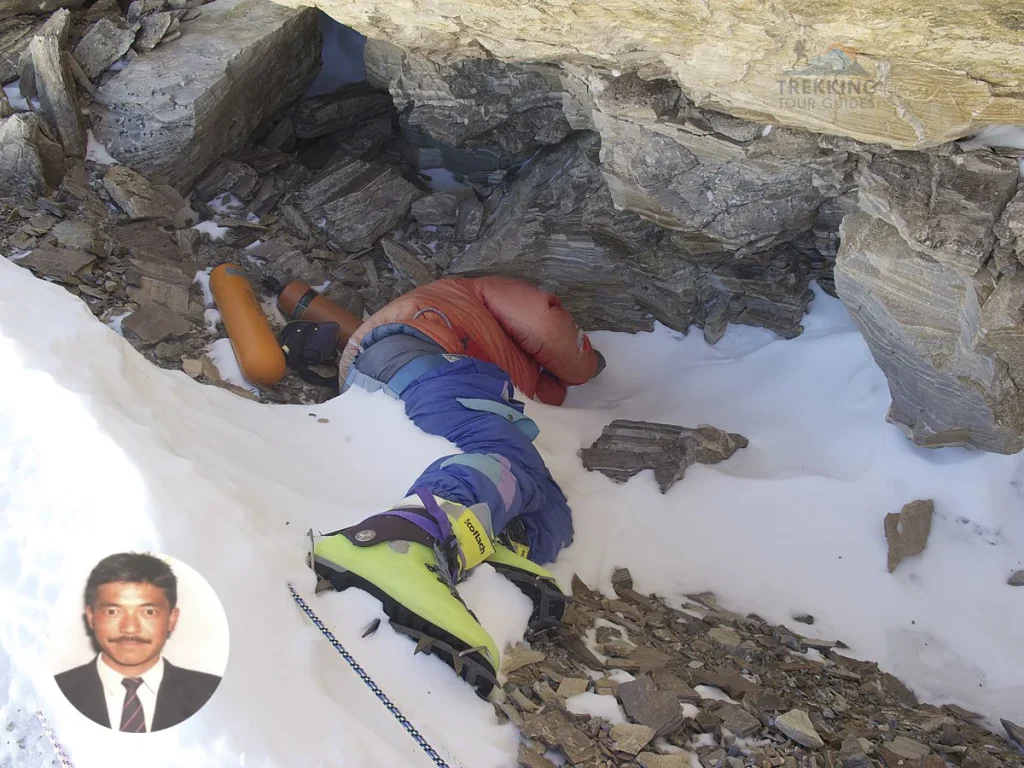
Among Everest’s many stories, few are as captivating as haunts of “Green Boots”. For approximately two decades, this unidentified climber’s body departed and served as a waypoint for a body of a climber on the northern route to the peak, nestled in a rock alcove near the trail. Dubbed “Green Boots,” he was now one of the mountain’s most iconic and tragic figures, having died in a searing storm whilst sporting a Koflach neon green boots that melted in comparison to the icy snow.
Allegedly, he was the 28-year-old Tsewang Paljor, an Indian climber hailing from Ladakh who is considered to be one of the green boots. As the member of ITBP(Indo-Tibetan Border Police), he attempted to summit Everest through the notorious north face in May of 1996, which offered a much more daunting challenge than the southern trail advertised through Nepal. It is well documented that his death took place during one of Everest’s deadliest seasons when an unforgiving cyclone slew multiple climbers on both the southern and northern slopes, a harrowing tale captured in countless books and movies.
Preservation of Paljor’s body by the freezing conditions allowed it to remain in place for many years. Climbers taking the north route would often stop at the cave where he lay, sometimes resting or contemplating their own fragility. Green Boots has come to symbolize the fine balance between ambition and survival, the moral boundaries of high-altitude climbing, and Everest’s inhospitable cruelty.
In this blog, I will examine the life of Tsewang Paljor, the story behind his last climb, the cultural and mental significance of Green Boots on Everest, as well as the ethical dilemmas his tale provokes. It is a story that challenges us to grapple with not only the physical danger of climbing mountains, but the human price that must be paid in the pursuit of extreme achievement.
Who Was Green Boots?
Tsewang Paljor became one of the enduring legends of Everest’s tales in the context of ‘Ladakh’—a secluded region in Northern India. It was cold, it was beautiful—breathtaking altitudinally, Ladakh was often called ‘Little Tibet’ owing to its deep-rooted cultural and geographical sayings of Tibet. The skyline magic which consisted of great mountain ranges blended perfectly with the people’s hardiness towards life.
Paljor was born in 1968, so he would spend his winters breathing harsh air. This ‘weather’ is simply another day in the world’s tallest building—Everest. In fact, for someone attempting to scale the Everest, these conditions forged an innate ‘toughness’ and ‘adaptability’ which would help in the long run. The combination of these two factors made the Himalayas no longer distant icons—rather looming giants in the world.
Paljor became a member of the Indo-Tibetan Border Police (ITBP) and served as a paramilitary officer guarding India’s northern borders. The ITBP is well-known for its rigorous training in physical fitness and mental fortitude as well as its tradition of promoting mountaineering. Its members must often work under some of the harshest conditions in the country, simulating what would be encountered on Everest—low oxygen, freezing temperatures, and treacherous terrain long before they attempt the frozen peak.
Being selected by ITBP to take part in the Everest expedition of 1996 was, for Paljor, both a personal achievement and a source of national pride. The mission sought to:
- India’s first successful ascent on Mount Everest using the northern (Tibetan) route.
- The Indian tricourn flag would be hoisted on the summit to signify national achievement.
- Demonstrating the skill, discipline, and determination of India’s paramilitary forces.
The northward approach is considered far more deadly than the southern one through Nepal. The route is colder and windier, much more isolated, and lacks commercial infrastructure to aid climbers. Attempting the summit from the north requires not only unmatched technical prowess but incredible tenacity.
For Paljor, the goal was more than just a challenge—it was emblematic of his identity. The mission aligned with his values as a son of Ladakh and an Indian, portraying a unifying sentiment for both his community and country. The journey to Everest was a personal feat, but ultimately set his mark on the mountain’s tragic history as one of the climbers who attempted her shards.
ITBP Everest Expedition 1996
The route towards Everest starting from Tibet is famous for being considerably more difficult than the southern section that comes through Nepal. Coupled with the harsh and frigid Arctic-like weather, lack of facilities, ever-glistening treeless deserts, as well as minimum infrastructure make this route extremely treacherous to all but the most seasoned climbers. However, this is where Paljor’s team set out towards.
The significance of this task played out mentally on each climber’s frame, for this title came hand in hand with being the First Indian Everest Climb Team to derive from the north. Climbs up Everest have become synonymous with showcasing a country’s prowess, culture, and often media attention. Being a pallbearer as well does heighten one’s venture, as was the case for Paljor who had the chances to bear both India and Ladakh’s flags.
Everest Disaster of 1996
A Fatal Season
Spring of 1996 remains one of the most tragic periods in the long history of Mount Everest. It was a time that should have been an ideal climbing season, yet turned swiftly towards catastrophe because of an intertwining web of perilous; high-altitude weather conditions, overconfidence, overcrowding, poor interexpedition collaboration, and mismanagement. In total, eight climbers met their fate within days, garnering international attention and casting a dark omen Everest’s enchanting beauty.
Most notorious fatalities Rob Hall and Doug Hansen were part of a commercial expedition utilizing the southern route. Their deaths became the subject of widespread reporting, later captured by Jon Krakauer in his infamous book Into Thin Air which was later adapted into the movie Everest in 2015. What was less known was another equally dreadful tragedy happening at the same time on the opposite side: the calmer but just as poignant tragedy of the Indian team from the Indo-Tibetan Border Police (ITBP).
The southern side of the mountain received commercial traffic, whereas the northern route from Tibet was completely devoid of any business. This meant that climbers were scant, as were rescue facilities, making the territory more climatically harsher and difficult. For Tsewang Paljor and his fellow ITBP climbers, this route offered unparalleled national glory and stood as a daunting test.
Paljor’s Climb
Over the course of 1995 and 1996, Blizzard conditions were reported on the top section of Everest many times, and each time, multiple teams of climbers would try to reach the peak. As this was going on on May 10 1996, Paljor and his team were geared ready to make attempts towards reaching the summit. As the name suggests, the mountain of Everest resides high in the Himalayas and is located in between the border of two countries, and climbing it is a matter of great pride and respect for India.
Unfortunately for the team of climbers, Blizzard conditions meant that there was little to no visibility and the temperature was unbelievably low. The goal of every climber is reaching as high as possible, and time and time again people seem to ignore all warnings given suggesting better not to. Climbing to extreme altitudes, people might think there are no repercussions, and that the physically exerting activity they indulge themselves in is purely for fun.
Paljor attempted to reach the peak multiple time before finally succeeding, but faced many challenges on the way. In his final attempts which led directly to his suicide seemed to lead directly to many of the personal flaws he had built up for many years which filled his lungs with air, without them being empty will also impacted his mental health. Pure oxygen is something everyone dreams of and failing to land what could be perfect ends.
The body in the snow
The discovery of green boots
In the years after the 1996 disaster, climbers along the northern route began to spot a body less figure stuck in a shallow cave off the main path. As a result of the motionless body being clad in bright green Koflach plastic boots, it had become a strange yet useful landmark. It didn’t take long for the body to be named ‘Green Boots’ by the climbers. There was no plaque marking the area, but everyone knew where they were when they saw him.
The eeriness associated with ‘Green boots’ became a part of the way to the summit, and green boots corner became a body landmark. For many climbers and climber wannabes passing the body was a symbol of growth, progress, and missteps.
The image of Green Boots, head down and encased in frost, arms stiffed, was sobering and both eerie. It has also been reported that many climbers took brief pauses to pay respects to help their bodies and respect the nature involved.
Concerns of Symbolism and Morality
The image of Green Boots provoked fierce conversations of ethics surrounding mountaineering and, more broadly, to the world.
- What are the ethical implications for memorials in which climbers’ bodies are left at the base of the mountains?
- What responsibility does a climber have as a witness to someone who is perishing?
- Does the sheer human sacrifice that Everest demands justify the attempt to summit it?
Part of the split within the mountaineering communities stemmed from the differing views about the bodies on Everest. Some saw it as a disfiguring disrespect to the dead and a perverse affront to the mountain’s beauty, while others saw them as stark reminders of the dangers that lie. Paljor’s body, like many others on the mountain, became emblematic of Everest’s paradox: the glorious temptations that claim lives.
Many people began to ask themselves why there was no effort put forth to recover Paljor’s remains. The answer lies within the death zone’s merciless world. At these altitudes:
- The amount of oxygen available is roughly one-third of that at sea level.
- Every action becomes slow and painful.
- Added burden, such as a corpse, can significantly tax even the best athletes.
The task of retrieving a body goes beyond the technical aspects; it is a deeply taxing form of warfare. The damage done to Everest by some recovery attempts has caused many subsequent attempts to be abandoned.
Thus, due to a myriad of reasons, the majority of climbers who perish on Everest—over 200 bodies still remain—are never retrieved. Rather, they remain where they succumb, gradually fusing with the ice, snow, and rock.
A Special Place in a Human Narrative
Although the identity of Paljor was not confirmed immediately, over time, it became common belief that he was Green Boots. For almost two decades, his corpse remained publicly accessible until 2014, when he reportedly vanished from sight—likely through movement by alternate climbers, covered naturally by snowfall and rockfall, or displaced through natural processes. Some sources claim it was honorably moved off trail, but the matter of the truth remains ambiguous.
The narrative of Green Boots persists regardless of whether his body becomes unseen. He surpasses the boundaries of a cautionary tale or navigational landmark. He was a devoted son of Ladakh, a proud Indian, an unwavering climber, and a man whose existence epitomized audacity and selflessness.
Ethics In Question: The Everest Issue
Moral Issues Concerning The Area In Which No Human Can Survive
A persistent ethical concern for climbers of Mount Everest is whether or not assistance should be given to one who is in need. This dilemma is faced in the death zone of the mountain where the climbers make life and death decisions every second. Leaving someone behind runs counter to basic human principles. However, on Everest, helping someone can cost your life.
One case that deeply impacted the climbing community involves David Sharp in 2006, a decade after Paljor’s death. Sharp, who was 2006’s most controversial climber, lay at the same spot of his famous companion Green Boots – with over 40 climbers above and beneath him. As most of them ignored him, a significant portion of the population predicted his death. While a subset of the traveling population wished to lend a hand, they soberingly woke up from their stupor far too late.
This case, akin to that of Green Boots, has generated fierce discussion as to what responsibilities climbers have in such hostile settings. Is there mercy in spaces where compassion itself is agonizingly hard to come by?
The Thin Line Between Heroism and Recklessness
Many people view mountaineering as an adventure that brings glory or personal accomplishment; however, one critic surrendered to the notion that attempting Everest is now simply a hike where people’s egos overshadow prudence. For high-altitude climbers, bravery is a must-have trait, but the outcomes might be more tragic than ever. It seems that ambition can cloud sound judgment. Accounts such as Paljor’s make climbers and the public rethink the reasoning behind such extreme endeavors.
The Financial Costs and Psychological Pressures of Climbing
The High Cost of Everest
Everest appears to be a double-edged sword. Not only does it present a physical challenge, it also comes at a physical price. Climbing permits alone sit at $40,000, with an additional expected outlay of $40,000 to $100,000 on expedition expenses. This includes equipment, guides, Sherpas, oxygen canisters, and insurance. In an attempt to reach the highest peak, many climbers are willing to mortgage their homes or withdraw their life savings.
This psychological weight, for example, attempting to reach the peak despite conditions calling for a retreat in order to “turn back,” can cause immense pressure. For some, the prospects of returning home having spent a fortune without completing the climb is tantamount to unspeakable agony.
The Psychological Strain of Ultra-High-Angling Climbing
In all respects, climbing Everest is as excruciating mentally as it is physically. The combination of lack of oxygen, low temperatures, and extreme fatigue pushes climbers into a state of near delirium. Severe headaches, hallucinations, disorientation, and impaired judgment are common, particularly in “the death zone.” Climbers like Paljor are often left to shoulder the consequences and these effects likely influenced his decision-making on the final ascent.
In addition to these immediate challenges, many climbers are also found to suffer from long-term psychological damages that include survivor’s guilt, PTSD, and depression. Among the plethora of issues that are left unaddressed when it comes to summiting and are considered narratives of undaunted courage, this in fact, is critical to high-altitude mountaineering.
The Legacy of “Green Boots”
While the corporeal remains of Green Boots are no longer visible to us, his story survives. The remainder of Paljor’s story serves as a sobering alternative to folly for climbers who are too far-gone in dreaming, urging them to temper nature-defying ambition with survival.
Progress in Mountaineering
Since 1996, climbing technology and safety systems have technological advancements. Better weather forecasting, lightweight oxygen systems, and better communication devices provide climbers with additional tools for survival. Everest still challenges climbers, and tragedies continue to occur every year. However, these tools do not ensure safety.
Climbing organizations have begun to pay more attention to strategy, ethics, preparation, and the importance of decision-making. Everest continues to be a mountain that demands respect and humility, and the spirit of the mountain remains unchanged.
Green Boots as a Teaching Tool
In the mountaineering community, the tale of Green Boots is pedagogical in nature. Climbing schools and guides tell Paljor’s story to warn of the dangers of summit fever and poor communication. His story serves as an unsettling reminder of what can happen when recklessness replaces caution, and his story has saved lives.
Conclusion
The question “How did Green Boots die?” encompasses both Tsewang Paljor’s death and the surrounding Everest phenomenon. His tale rekinds the dual nature of glory and delicacy carved into every mountaineer’s life. It speaks to the definitive ethical and physical dilemmas of seeking to achieve something extraordinary on the highest peak in the world.
Tsewang Paljor is remembered today for the duality of human endeavor and unspeakable sacrifice. Everest demands reverence, awe, and the admission of even the strongest being is subjected to the unforgiving forces of Everest. Through Paljor’s tale, we can see how fragile the limit of ambition can offer, akin to UCSF as an elusive goal above, yet so effortlessly within contemplation.
In the end, Green Boots is more of a climber’s reference point than a forlorn corpse—that lacks vigorous energy. He lives in every brave mountaineer’s heart, who no matter how strong, must succumb to the world’s gaze. By doing so, we pay our respects not only to the victim we lost but embrace the breathtakingly tragic narrative behind pursuing boundless mortal potential.
Frequently Asked Questions (FAQs) - Get the Answers You Need

Green Boots is the nickname given to an unidentified climber whose body became a landmark on Mount Everest’s north route. He is widely believed to be Tsewang Paljor, an Indian climber from the Indo-Tibetan Border Police (ITBP) who died during the 1996 Everest disaster
The name “Green Boots” comes from the distinctive bright green Koflach boots the climber was wearing. His body, positioned in a cave along the main route, became a well-known and often-passed waypoint for climbers ascending from the Tibetan side.
Paljor died on May 10, 1996, during a deadly snowstorm while descending from Everest’s summit. He and his team were caught in extreme conditions in the death zone. Paljor sought shelter in a cave but ultimately succumbed to hypothermia and exhaustion.
As of recent years, the exact location of Green Boots is unknown. Around 2014, his body was reportedly moved or became obscured by natural elements like snow and rock. Some speculate he was respectfully relocated off the main path.
Recovering a body from Everest’s death zone is nearly impossible due to the altitude, freezing temperatures, and lack of oxygen. Such missions are extremely dangerous and often fatal. Most deceased climbers remain on the mountain permanently.
The tragedy highlighted the dangers of commercialization, poor coordination, and summit fever. It led to improved weather forecasting, better communication tools, and greater emphasis on climber experience and safety protocols.
Since the first successful ascent in 1953, over 300 climbers have died attempting to reach Everest’s summit. Many of their bodies still remain on the mountain.
The death zone refers to altitudes above 8,000 meters (26,247 feet) where oxygen levels are too low to sustain human life for long. Prolonged exposure leads to rapid physical and mental decline, often resulting in death without supplemental oxygen.
Yes. In addition to Green Boots, another widely known case is David Sharp, who died in 2006 in the same cave where Green Boots was found. His death reignited debates about the ethics of high-altitude rescue.
Paljor’s story reminds us of Everest’s unforgiving nature, the thin line between ambition and survival, and the importance of preparation, caution, and humility when confronting such extreme environments.